
A page can perform well in search engines and still be missing from conversations online. People are now increasingly relying on AI tools to compare, learn, and research products or companies. This has created a visibility gap. Ranking well in Google does not always translate into good presence in AI-generated responses anymore.
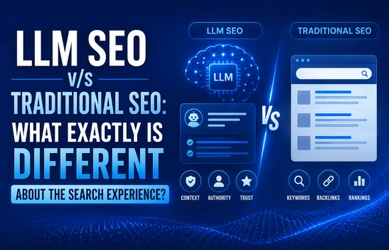
The essence of traditional SEO remains the same: gaining visibility through search results. The key point to consider when comparing LLM SEO vs SEO lies in what happens after that.
While traditional search directs users to ranked web pages, AI search is able to summarize the information, compare the options, and provide references right in the answer.
The two are interconnected, and yet they have different purposes. The knowledge of that is key to figuring out what should be carried forward from SEO.
Key Takeaways
- Traditional SEO revolves around rankings and organic clicks. LLM SEO encompasses citation, mentions, recommendations, and proper brand representation using AI
- There are some similarities as well. The importance of crawlability, valuable content, internal linking, technical quality, authority, and relevance persists.
- The scope of optimization broadens. Unlike traditional SEO, which concentrates solely on keywords and pages, LLM SEO takes into consideration entities, questions, context, evidence, and branding aspects.
- It is necessary to be original. Anyone can create a summary of content available online. However, original insights, research, data, and analysis can offer something valuable to the AI algorithms.
- Measurement should adjust for AI visibility. Rankings and traffic are relevant metrics, but one needs to monitor citations, mentions, sourcing, and competitors.
LLM SEO V/S Traditional SEO: What Changes?
In traditional SEO, it becomes important to take care of the indexing, ranking, and click-throughs for the page. However, in LLM SEO, we need to think about the retrieval process, evaluation process, and also the AI that uses the sources to form its answer.
Traditional SEO: Rankings, organic visibility, and clicks.
LLM SEO: Retrievals, mentions, citations, recommendations, and brand visibility.
There is a shift from the rankings of the pages to the visibility of the content, entities, sources, and the brand itself. There is no formula for ranking in LLMs, and each of the AI platforms has its own retrieval method.
Google AI Overviews can perform multiple searches, while ChatGPT Search can perform query reformulation and web source retrievals.
|
Traditional SEO |
LLM SEO |
|
Rankings and organic clicks |
Mentions, citations, and recommendations |
|
Keywords and search intent |
Questions, entities, and context |
|
Page-level optimization |
Brand and topical visibility |
|
Search results |
AI-generated answers and summaries |
|
Links and on-site authority |
Evidence and source corroboration |
The foundations are unchanged. Just the goal became broader.
Traditional SEO Remains the Core
One of the biggest knowledge gaps that can be found in most of the articles discussing the issue of LLM SEO is the overestimation of the degree of this revolution.
However, the official Google documentation seems to be far more pragmatic.
As Google says, no special AI markup, extra technical files, or optimization of the website is required to be done for the website in order to appear in AI Overviews and AI Mode.
It means that a poorly optimized site is still going to perform worse despite the presence of the "AI SEO services" page on the home page of the website.
For the sake of proper consideration of LLM SEO, one needs to make sure that such fundamentals are taken into account:
- Crawlability and indexability of important pages
- Logical connection between the related content with the help of internal links
- Compliance of the pages with their search intent
- Originality and value of the content
- Proper business and authorship information where necessary
- Correct structured data according to the visible content
Absence of technical issues that could stop the search engines from gathering the right information. It is exactly here where LLM SEO and traditional SEO meet.
Where the Approach in LLM SEO Actually Gets Changed
The major change takes place at the level of information instead of keywords.
1 - From Keyword to Question and Entity
In order to perform LLM SEO, one needs to approach the language users use to define their problem. Traditional SEO always begins with keyword research.
For instance, we can think about a fictional accounting software company. And its traditional SEO will involve keywords such as: accounting software, accounting software for small businesses, and accounting software for startups.
LLM SEO would consider the following questions as well:
- Which accounting software is better for a small business?
- Which accounting software integrates with Shopify?
- What do I need to consider while selecting the best accounting software for a startup?
- Which accounting platforms are suitable for multi-entity businesses?
Keywords' rephrasing is not enough.
The brand needs to be treated as an entity - its product, target audience, problems solved, and its unique features.
That is why using the same keyword 15 times does not work as efficiently as building topical and entity relationships.
2. From Self-Claimed to Verified Authority
A company could place on its website “a leading cybersecurity company in the industry”. This type of statement holds little value on its own.
An authority profile may include expert insights in publications, reviews, research, awards in the field, valuable first-party resources and consistency in describing the company in other reliable sources.
It does not imply that an organization should artificially create references in order to influence the algorithm.
Google's recommendations stress the importance of experience, expertise, authority and trustworthiness of an entity while discouraging manipulative content.
3. From Generic Information to Original Information
This may be one of the greatest distinctions in AI search. It can generate summaries of existing information. Your article stating the same thing as 50 others does not offer anything special.
Only original information can resolve this issue.
For instance, a digital marketing company may produce an opinion poll from 500 marketers regarding the adoption of AI in search, provide the methodology used, analyze the results, and disclose the source data.
Such a resource will serve as a reference, but not just another article defining "what is AI SEO?"
Google's advice on creating content recommends producing original research, analysis, reporting, and valuable information, instead of publishing material that has already been published elsewhere.
Keep Content Clear and Useful
Content that's optimized for AI search does not have to be turned into a dictionary entry of definitions and FAQs.
Yes, clarity is important, but so is context. Start with the answer to the question when answering it, then explain the evidence behind the answer and give the context.
Example:
What is LLM SEO?
LLM SEO is a way to optimize the brand's content in the sense of making it more discoverable, understandable, and citable in AI-driven searches.
This creates a solid foundation for the reader and search engine. The rest of the section can be used to provide more examples and context.
And this is the place where the AEO and LLM SEO come together. Give an answer and back it up.
What Signals Are Important for LLM SEO?
No official list of "LLM ranking factors" exists for all AI platforms. At least, there's no consensus on a specific list of signals among the available guidance and studies. There appears to be agreement on the following five categories: accessibility, relevance, clarity, authority, and corroboration.
Accessibility and Crawlability
AI searches still require access to the information.
Google expects that the pages used in AI search experiences meet regular Search technical guidelines. OpenAI has published OAI-SearchBot as the crawler used to discover websites to power ChatGPT Search.
Blocking relevant crawlers or making the information hard to find clearly prevents discoverability.
Clear Information
The page must answer important questions clearly. If certain factors such as pricing, compatibility, limitations, or eligibility impact the buyer, do not obscure the details behind vague marketing copy.
Topical Depth
One article will not make you an expert in the whole field. A better website would explore key sub-topics that relate to the general topic and tie them together.
This doesn't mean that you should write 50 flimsy articles just because you got 50 different variants out of the keyword tool.
Use real customer inquiries and topical connections.
Entity Consistency
The name of your company, your products, services, people, locations, and other entities should be consistent across your website and relevant third parties.
If there's a discrepancy between what you say on your website, what you say on your profiles, and what third-party sources say, there's more conflicting information for the AI to deal with.
It could impact the accuracy of your brand representation.
Third-Party Evidence
Outside sources could back up your claims. Reviews, industry sources, expert content, research, and any other relevant third-party content could add value to your authority signal.
But relevance counts. Ten irrelevant mentions are not necessarily better than one authoritative one.
Rankings Alone Are No Longer Sufficient
The traditional SEO report consists of metrics like rankings, impressions, organic traffic, leads, and revenue.
They are still vital. But AI search optimization introduces another aspect: what if the user doesn't have to click through to your website in order to find out about your brand?
According to Pew Research Center, when there was an AI summary presented in its 2025 study on Google users, only 8% clicked through to any of the traditional search results, compared with 15% when there was no AI summary. Just 1% of those clicks were made to a hyperlink in the AI summary.
This does not mean that website traffic is not relevant anymore.
It means that search visibility cannot be equated to clicks anymore.
A useful LLM SEO measurement framework should include tracking of:
- Brand mentions in relevant AI answers
- Frequency and sources of citations
- Competition by similar prompts
- Accuracy of brand descriptions
- Recommendations
- Sentiment or positioning, when applicable
- Organic rankings and traffic
- Legends and conversions due to search
And the point is consistency. Test a fixed set of commercial and informational prompts consistently rather than check manually one or two questions.
Better Way to Combine SEO and LLM SEO
There's no reason to pursue two different strategies for SEO and LLM SEO. Start with SEO and build on those efforts with factors that make a difference for AI-powered searches.
|
Focus |
Actions |
|
Technical SEO |
Maintain crawlability and indexability of all critical pages. |
|
Search Intent |
Broaden your approach from targeting keywords to addressing questions, comparisons, issues, and use cases. |
|
Topical Depth |
Create useful coverage on a topic rather than making articles for each variation. |
|
Brand Signals |
Clarify and maintain consistency on your brand, offerings, expertise, individuals, and other relevant entities |
|
Authority |
Create credibility through digital PR, expert contributions, original research, reviews, and media coverage. |
|
AI Visibility |
Analyze mentions, citations, recommendations, competitors, and gaps for relevant AI queries. |
In essence, integration is the key. LLM SEO shouldn't be an effort limited only to content. It's possible to have a well-written article that struggles with technical SEO, poor topical depth, or a lack of credible authority of the brand outside the site itself.
What Does This Mean For SEO?
AI search does not mean SEO starts anew from scratch; it simply means broadening the definition of success for your search strategy.
The page will have to continue ranking, attracting traffic, and converting visitors. However, it must also be able to surface when the user asks the AI search platform the same query, question, or request regarding the same topic, brand, product, or service.
This implies that SEO teams cannot rely on rankings.
An optimal search strategy now involves:
- Checking whether the brand ranks in regular search results
- Whether the content answers related questions
- The consistency of the brand on the internet
- The sources that AI platforms use for answering such queries
- If any competitor brands are being referenced
- The unique information that the brand offers
Optimizing the page and analyzing its search presence is the key here. Traditional SEO continues to play an integral role. LLM SEO adds to the scope of this foundation.
Which Should Your Business Focus On: LLM SEO or SEO?
If you have a weak SEO foundation, start there. Chasing AI citations when there are pages that are poorly structured, hard to crawl, thin, or disjointed from the rest of the website is of no use.
But if the basics are strong, LLM SEO is the next natural layer.
Understand how your brand gets cited within AI-powered answers. See what the questions being asked are; focus on more than just keywords. Understand who else is getting cited by your competitors. Analyze what sources are used by AI systems. And then fill in the gaps through improved content, entity signals, original research, and technical SEO.
At AdsRole LLC, we offer you comprehensive AI SEO services to help build strong search visibility for your brand.
FAQs
No. LLM SEO is a continuation of SEO. Accessibility, valuable content, internal links, relevancy, and authority will always be relevant in modern search experiences.
The concepts are overlapping in nature. LLM SEO is a term that mostly denotes optimization for visibility within large language model experiences, whereas AI SEO is a broad term denoting optimization within AI-powered search and discovery.
Yes, but only partially, especially if AI search retrieves the data from the search indexes. Ranking high in Google will not automatically result in a citation in an AI-generated answer.
There is no special schema for Google's AI search capabilities. It is recommended to apply the supported schema correctly and have it reflect the visible page content.
Analyze the most important questions on your topic, provide unique content, structure the page logically, build topic authority, support facts, and ensure technical accessibility. Do not write for keyword variations only.
Certainly, especially when such businesses are highly knowledgeable, focused on a specific niche, hold useful information for their locale or industry, and possess outside verification. Knowledge specialization may sometimes be better than generalization.
There is no consistency in this matter. GEO is usually understood to mean Generative Engine Optimization, whereas LLM SEO focuses on large language model discovery. Nevertheless, the approaches are quite similar.
Employ a consistent set of pertinent prompts and evaluate mentions, citations, recommendations, competitors, source selection, and brand accuracy. Also consider standard SEO and conversion measurements.