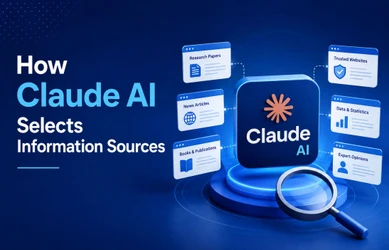
When someone asks Claude for a recommendation, comparison, or explanation, the answer is generally sourced from different sites and webpages. But why does Claude AI Search choose one source over the other? How does it pick which page deserves to be referenced?
When it comes to businesses using Claude AI SEO, the latter is a much more valuable question because visibility in Claude AI Search goes beyond the optimization of the web page.
The relevance of the content, the authority of the site, evidence, expertise, brands, and clarity of the information have their say too. Below, you will find out how Claude AI Search picks its information sources.
Key Takeaways
- Web access is paramount. Claude won't even consider the rest of the optimization process if a webpage fails this criterion.
- Relevance is critical. Whether or not a website can be considered a source is determined by how relevant the content is to the user query.
- Evidence is crucial. Concrete data, specific statements, credible references, and expert opinion give Claude stronger material to work with.
- The website is just a part of the equation. Third-party references in independent articles, reviews, journals, and industry sources are all important factors for your brand.
- Clear writing is important. Segregation into logical segments, clear answers, descriptive titles and standalone passages of information can increase retrieval and usage.
- SEO basics are integral. Web crawlability, indexed content, internal linking, web accessibility and valuable content continue to hold value.
- Claude's visibility needs to be gauged via citations and mentions of your site. The goal is to be cited as a credible source.
Claude AI Search Begins With Retrieval
Claude's web searches provide access to current information and enable citation within responses. Anthropic's documentation also describes various crawlers, including ClaudeBot, Claude-User, and Claude-SearchBot. Thus, access becomes the very first consideration.
Even a perfectly written article will never become a Claude source if there is no way to retrieve relevant information. Before implementing any changes to your content strategy, ensure that necessary pages are publicly available, crawlable, internally linked, and formatted properly for processing by search bots.
Here are some basics to be checked:
- Is important information available in the text?
- Are pages internally linkable?
- Are robots.txt, CDN, firewalls, or hosting settings blocking necessary crawlers?
- Do pages clearly describe their topics through titles, headings, and body copy?
- Is the information you wanted cited actually present on the page?
The point is also in line with Google's current recommendations regarding AI search visibility. Google still emphasizes the importance of traditional SEO factors like crawlability, internal linking, access to textual content, and correct use of structured data.
AI search will not eliminate technical SEO. It will just increase the importance of access to relevant information.
What Makes a Source Worth Citing?
Claude SEO recommendations are abundant on the web and take observations and make them into ranking guidelines.
You will find statements such as that Claude favors one search engine over another, has a preference for some schemas or follows an order of authority when ranking. Without Anthropic specifying these traits of Claude's behavior, they have to be taken as observations or hypotheses, not rankings.
More sensible would be to think about what makes a source relevant to a particular question.
|
Criteria |
Meaning |
SEO Response |
|
Relevance |
The source has a direct relation to the query |
Create content that matches the search intent. |
|
Evidence |
The claims can be verified or substantiated |
Provide facts, research, references, and examples. |
|
Expertise |
The material reflects the subject knowledge |
Hire experts, use authentic expertise. |
|
Clarity |
The key information is easy to understand |
Use clear answers and headings. |
|
Consistency |
The product and brand are represented consistently |
Align the information on your site and third-party sources. |
|
Freshness |
The material stays relevant to the query |
Review time-sensitive content regularly. |
|
Accessibility |
The source can be accessed |
Easy access to relevant pages. |
|
Independent validation |
The claims have support outside the brand's site |
Build the mention in the industry. |
These criteria must not be used as an official Claude scoring system. It is just a way to see which factors make content citable.
Give Claude Something To Work With
Generic statements don't provide very many clues for the AI's search process. Specificity, evidence, and original insights will.
Instead of writing: “SEO for enterprises should be done strategically.”
Provide the reader with something more concrete. Check the text below to understand this better:
“Enterprise SEO frequently entails coordinating among several teams in charge of international site management, infrastructure, and large-scale migrations, as well as being as crucial as keyword targeting.”
What makes strong content?
- Research and proprietary data
- Benchmarks and surveys within an industry
- Insights from experts or from personal experience
- Methodologies that have been documented
- Examples and evidence
The purpose is not to create research for the sake of it. It's to give Claude something to work with that he wouldn't find elsewhere.
Relevance Trumps Authority
Even a highly authoritative domain might not always be the best place to find an answer to a certain query. The relevance factor plays an equally important role.
For instance, when Claude asks what a B2B SaaS company needs from an enterprise SEO agency, a general SEO article would probably not be as valuable as a specialized piece of information on:
- Enterprise website structure
- International SEO
- Technical SEO governance
- Enterprise migration services
- Large-scale SEO measurements
While the most authoritative sources are not always the largest sources of content, they are definitely the most helpful ones for certain queries.
What should the content teams keep in mind? Start by looking past the high-volume keywords and developing content in areas where there is real expertise. Consistency will help build a strong topical authority signal.
Website Is Not The Entirety Of Your Brand Authority
Your website defines what your company does. There are other sources that define and support your description.
Claude AI Search considers all of that to be essential for your brand. It could be talked about in industry publications, review sites, partner websites, interviews, comparison pages, and professional directories. As all of those sources refer to your brand, there is no doubt about your brand identity.
It means that entity consistency is crucial in Claude AI SEO.
It is time to look at how your brand is reflected in third-party sources, especially:
- Company and product descriptions
- Services and industry positioning
- Leadership and author mentions
- Reviews and external profiles
- Industry publications and collaborations
The motive is not to accumulate mentions, but rather to build a credible, consistent digital footprint.
Make Important Information Easy To Understand
Claude does not require your content to follow some kind of “AI SEO template.” What it needs is useful information. This means the editorial structure matters.
|
Less Effective |
More Effective |
|
Long introduction before answering |
Answer the question at the beginning |
|
Vague headlines like ‘Why it Matters’ |
Specific headlines that define the topic |
|
Unsupported claims |
Claims supported by evidence or appropriately qualified |
|
Promotional blocks of text |
Useful self-contained informational sections |
|
Generic definition |
Definition followed by useful content |
|
Keyword variations everywhere |
Natural terminology and concepts associated with the subject |
This is where SEO, AEO, and GEO converge.
For example, if you want to tell someone the difference between enterprise SEO and SEO, do not make them wade through 700 words of background information to get their answer.
Answer the question first. Then explain the nuance. Then provide support with evidence, an example, or additional information.
As several studies in 2026 on citation selection on generative search engines found, pages that had stronger structure and contained more extractable information like definitions, numerical facts, comparisons, procedures, etc., tended to be more influential when cited.
Expertise, Freshness, and Structured Data Still Matter
Expertise needs to be conveyed via the content. While author information is valuable, expertise needs to be demonstrated through professional experience, research, expert commentaries, and contributions to the subject matter.
Freshness is important for timely information updates. If pricing, regulations, features of the product, market information, and benchmarks change, then the publication date is supposed to reflect this change.
While structured data allows minimizing confusion, it is not a tool that can provide you with Claude visibility. Use structured data to describe information about your organization, authors, products, and other entities that is clearly visible on the page. According to Google guidelines, structured data must match the content.
The point is quite straightforward: it is necessary to make sure that expertise, freshness, and entities become clear to users.
Optimize Content To Work With AI Search Information
With the foundational authority signals sorted out, the next part is making it easier for AI search to access and use that expertise.
In the case of AEO, readability is key. Place the answer closer to its question, use proper headings, define essential terms, distinguish facts from explanations, and the user should be able to quickly grasp the gist without reading through all the unnecessary text.
Example:
Ques - What is enterprise SEO?
Ans - Enterprise SEO refers to the optimization of complex or large-scale websites where additional difficulties arise due to scale, multiple stakeholders, infrastructure, and governance of a website.
Further explanations may follow.
This format not only makes the page easy to read but also enables the creation of self-contained pieces of information that do not necessarily rely on context.
When it comes to GEO, one should take things a bit further. The page should provide some value-added for the topic in the form of original research, expert insights, analysis, comparison, benchmarks, observations, and any other valuable data.
Ensure That Each Important Statement Is Supportable
An easy way to determine whether a statement is important is to ask yourself: Can another source prove this claim?
Content about trends, capabilities, performance, statistics, and results should be supported with appropriate information. If you have found such information in your own research or experience, include how this was accomplished.
This benefits AEO and GEO because the content becomes more easily understood and more credible.
Base Content On Real Information Requests
Do not build content solely on keyword searches. Instead, build content based on the information needs associated with your topic.
A good resource could address the key question first and follow up by covering the other related issues, including the common mistakes, other options, how-to aspects, and support information.
This allows you to build an information resource deeper than a mere set of keywords.
Test Your Customer's Real Questions
Instead of checking whether your website is “optimized for Claude,” test your customers' real questions during research.
Try to use realistic prompts such as:
- What are the best project management tools for distributed teams?
- What should a startup consider when selecting an SEO agency?
- What features should be compared when choosing a provider?
But also pay attention to things other than whether or not your brand is cited:
- What is being cited? What sources does Claude use, and which ones repeat themselves?
- Who is being mentioned? Pay attention to your competitors who appear again and again.
- What is missing? Try to compare the cited content with yours. Does your competitor provide more accurate sources, more specific answers, or something else which is not covered by you?
- How is your brand cited? Check whether or not Claude provides a proper description of your company, products and services.
Don't evaluate the performance by one citation only. Try to run the same prompt several times and analyze the results.
Claude AI SEO Workflow That Gets Results
There is no need to have a complex process to improve Claude AI search visibility. A simple workflow can get you started in making Claude AI more visible:
1. Identify The Most Relevant Queries
It will be necessary to focus on research, comparative and purchasing queries, as those where Claude's visibility will have an impact.
2. Analyze The Current State Of Affairs
Use several prompts, paying attention to the sources that Claude cites, competitors and how your brand is mentioned.
3. Identify Gaps
Examine carefully the sources that are being cited. They may have something that your content lacks in terms of evidence, details, freshness, originality and other aspects.
4. Create Visibility For Yourself
Enhance your content and create credible mentions beyond your website using research, digital PR, expert contributions, industry content, partnerships and reviews.
5. Watch The Trend, Not Just One Citation
Repeat the same prompts and monitor their citations, mentions, competitors and accuracy of your business description.
Here Is What Most Claude SEO Advice Gets Wrong
Much of the Claude SEO advice out there assumes that some observations are ranking factors. If there is any reference to a particular search engine, predetermined source order, promised schema, or freshness threshold, this claim should be taken with a grain of salt unless Anthropic has made any documentation.
Anthropic has confirmed that Claude can search the internet and uses its own crawlers, among which Claude-SearchBot is mentioned. However, there is no publicly available ranking formula which can be analyzed by marketers and translated into the checklist.
The better option would be to concentrate on things you can influence:
- Availability: Can Claude access your content?
- Relevance: Is it relevant to the query?
- Evidence: Does it provide valuable information in relation to the query?
- Clarity: Is the information clear and extractable?
- Consistency: Is your brand consistent on the internet?
- Validation: Are there credible sources confirming your expertise?
Claude AI Search Is Only A Part Of Overall SEO Strategy
Claude represents only one element within AI search. A potential customer might find out about your company via Google AI Overviews, compare offerings via ChatGPT, conduct research on Claude, and ultimately end up on your website.
All of these visibility opportunities are based on the same elements: available content, research, expertise resources, accurate brand information, trustworthy third-party references, and comprehensive topic coverage.
Google itself verifies that its AI search experiences still remain grounded in traditional SEO fundamentals rather than a different set of "AI-only" optimization elements. Google Search Central
Your ultimate task isn't ranking in Claude. It's visibility in AI search overall.
Ready To Improve Your Search Visibility in Claude?
Since Claude offers no publicly available algorithm for citation on their platform, the search for Claude ranking hacks will likely be futile and won't contribute to long-term visibility. Instead, one can focus on producing valuable information that is evidence-based, accessible, and trustworthy.
Answer the questions that your target audience has. Use facts to back up important points. Show your expertise, maintain consistency in brand information and develop credible third-party references. Finally, test whether your brand and content are visible in relevant AI searches.
If your website ranks high on traditional search engines but doesn't show up in Claude results, AdsRole LLC offers AI SEO services along with expertise in AEO and GEO to help your business.
Do you want to know how visible your brand is in AI search?
Schedule a free consultation with us and make your AI Search Visibility measurable.
FAQs
Claude can conduct web searches to obtain up-to-date information from several sources, and its answers will cite them for users to view the information on which their responses are based.
Anthropic does not officially confirm the utilization of Claude's web searches via Google Search results. Hence, any statements about Claude using Google Search are not considered part of the Claude SEO guidelines.
Claude AI SEO refers to the improvement of the site's accessibility, relevance, content quality, expertise, evidence, and overall branding to increase the chances of its information being found and cited.
Yes. Accessibility, linking, quality content, site structure, and helpfulness are still essential components that make sense despite the existence of an additional visibility method via AI.
Website authority can be one of the criteria for the quality of the source. However, it should not be considered the only ranking factor.
Structured data will help identify the entities on the page and provide clarity in page info, but there are no confirmed cases of schema guaranteeing Claude citations. Markup should correctly represent what is visible.
Develop a set of commercial and informational queries for tracking, run them from time to time, and write down brands mentioned, competitors, and citation sources. This will help you form a more informative visibility baseline.
Backlinks can help increase the authority of the website, but backlink quantity is not a metric useful for AI visibility. The relevance and context of the reference are also important.
Generally, no. Develop helpful content based on users' questions and test its performance on AI search engines. Testing on each platform is more useful than developing new content.